

- The Fenix 9x line from Garmin has long been known as one of the top multisport / outdoor-ready GPS smartwatch series. It’s aimed at adventurers, athletes, hikers, endurance-sport lovers and anyone who wants a rugged watch that can handle extreme conditions while offering deep training, navigation, and health features.
- Features that typically define a Fenix watch: robust build (durable bezels, scratch-resistant lenses, water resistance, shock/thermal resistance), GPS-based navigation with maps, multi-sport tracking, health monitoring, and long battery life — making it suitable for long treks, hikes, runs, even diving or extreme-weather conditions.
- The recently launched generation (e.g. Fenix 8) upgraded the line with AMOLED displays (alongside traditional MIP / solar options), improved mapping & navigation (TopoActive maps, global ski/golf maps, multi-band GPS), and enhanced sport + health tracking (VO2 max, endurance/hill/climb scores, strength training plans, dive support, body-battery & stress tracking) — while still being rugged and versatile.
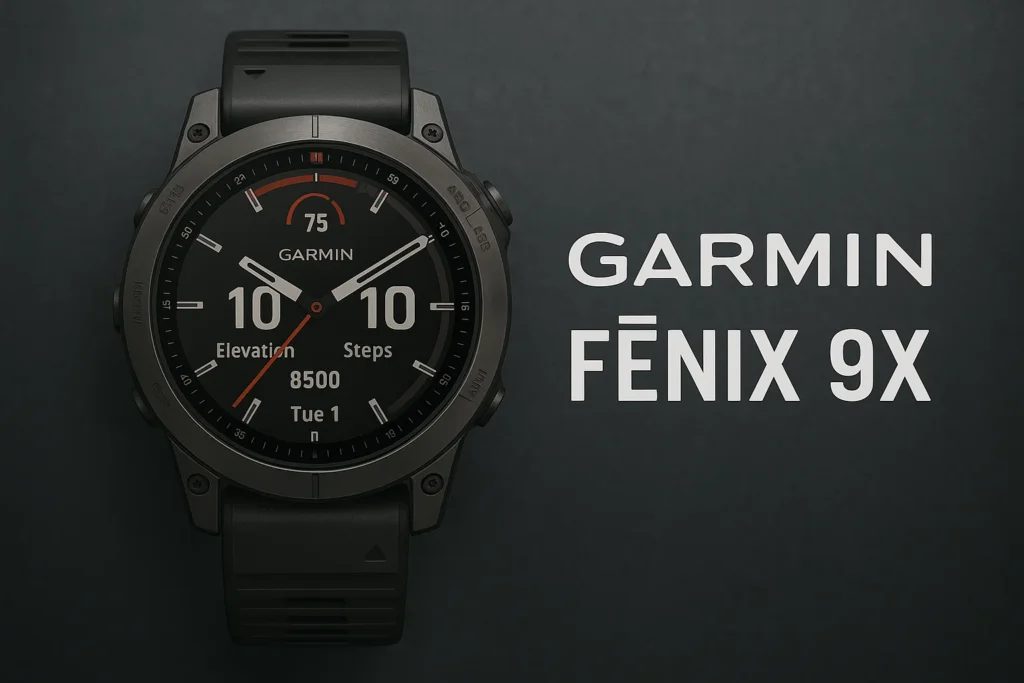
Why people love Fenix watches: a true “take-anywhere, do-anything” smartwatch — whether you’re running, trekking, swimming, diving, or just want a reliable everyday fitness + health + smartwatch.
What we expect / hope for in the Fenix 9X
Assuming Garmin builds on the strengths of Fenix 8 + listens to community feedback, here’s what Fenix 9X could deliver (or what many would like it to):
| Feature / Improvement | Why It Matters |
|---|---|
| Stronger battery + more efficient display (AMOLED / MIP / solar hybrid) | Fenix watches are often used for long outdoor treks or multi-day adventures — better battery ensures reliability during long runs, hikes, or trips. |
| More accurate GPS & navigation (multi-band, satellite fallback, better offline maps) | For hikers, trekkers, mountaineers — accurate positioning and reliable maps are critical. |
| Expanded sport/activity tracking (more activity modes: climbing, skiing, diving, adventure-sports, maybe new workouts) | Makes the watch more versatile for a broader set of users and sports. |
| Advanced health tracking (sleep, stress, HRV, SpO2, maybe newer sensors) | Health / recovery metrics help not just athletes but everyday users focused on wellness. |
| Improved ruggedness / water-resistance / dive-readiness | For adventurers, durability and waterproofing remain essential; dive support is a big plus for divers or water-sport fans. |
| Smartwatch features: music control/storage, notifications, contactless payments (if supported), maybe phone-less connectivity (LTE / satellite for emergencies or messages) | Makes it useful not just for sports, but also for everyday use — without needing a smartphone nearby during adventures. |
| Better user interface and mapping UI (faster map redraw, easier route planning, “round-trip routing” / dynamic navigation features) | Smooth UI enhances real-world usability — especially outdoors where scrolling maps must be quick and reliable. |
Some of these expectations come directly from what’s already available in Fenix 8, and some are based on what users commonly request in community forums (e.g. smoother maps, better battery, more features). For example, many in the Garmin community have shared a “wish-list” for Fenix 9 or next-gen model that includes better GNSS performance, more battery life, more activity types, maybe LTE without subscription, etc.
Who is Fenix 9X built for — Ideal Users
- Outdoor adventurers & hikers: If you trek, hike, mountaineer, or travel off-grid, the combination of GPS, offline maps, durable build, and long battery life is ideal.
- Athletes & runners (all levels — from casual to pro): Marathon training, trail-running, cycling, climbing — Fenix handles many sport modes and training analytics.
- Fitness & health enthusiasts: For those who want continuous health monitoring (heart rate, sleep, SpO₂, stress, recovery), plus training insights.
- Frequent travellers / commute / everyday use: Whether daily walk/jog or weekend trail, Fenix offers smartwatch-plus-sport functionality — good for someone who wants one watch for everything.
- Adventure + everyday lifestyle mix: For people who don’t want to switch watches when going from office to gym to trail — rugged looks + smart features = versatility.
What to keep in mind, and possible drawbacks
- Because of the rugged and feature-rich build, these watches tend to be big and heavier than typical “fashion” smartwatches. That might feel bulky if you prefer light or minimalist wearables.
- Rich features + GPS + maps + sensors = battery drain if you push all functionalities (maps, GPS, always-on display) together. So optimal use often requires managing features to maintain battery life.
- Premium price range — such watches tend to be expensive (given Garmin’s build quality and feature set), so it’s more an investment than a casual purchase.
- For “just casual fitness tracking or everyday smartwatch use,” the full power of Fenix may be overkill; simpler smartwatches might suffice.
Interestingly, some community feedback on current-gen Fenix watches highlights tradeoffs: e.g. some users find UI a bit slower compared to mainstream smartwatches, screen visibility in some conditions could be better, and for non-adventurers some features seem underutilised.
Final Thoughts
If Garmin releases a “Fenix 9X” that builds on the strengths of Fenix 8 — ruggedness, mapping, battery life, sport + health tracking — while improving GPS accuracy, UI fluidity, battery efficiency and perhaps some phone-less capabilities, it could be among the best all-round multisport smartwatches out there.
For anyone who loves outdoor adventures, runs, hikes, or simply wants a watch that can handle extreme conditions and act as a capable smartwatch — Fenix is a compelling choice. But if you mostly need step-tracking, casual workouts, or a light daily wearable — you might find it “too much watch for everyday use.”